“Hey, Y’all!” – What’s Left Behind When Your Butter Empire Crumbles

Oh, Paula Deen ….

179789_10201512375551696_1357558147_n

Paula Deen Facebook Meme.

What is wrong with people? Are we all just hell-bent on destroying ourselves? Maybe. And the latest high profile personage to hit the self-destruct button is Butter Queen Paula Deen, the multimillionaire face of Food Network’s home cookin’ empire.

Deen has been all over the news for the last week or so since a lawsuit brought by a former employee in 2011 came to light and Paula’s deposition has been made public. And whaddaya know: ole Paula comes off as racist as all get out. Actually, if you read the whole thing — find it online; it’s kinda unbelievable — the person who comes off the worst is not Paula, it’s her brother, Earl “Bubba” Hiers.

Deen’s first mistake was not firing his mongrel ass a long time ago. The second mistake (hand in hand with the first) is this ill-formed belief that family always comes first and everything else second — even when it’s family that’s going to bring you down. And third, and perhaps most importantly, Paula needs to get her ass up out of Georgia and get a perspective on the situation that’s not tinged with inbred Deep South racism.

You can talk a good game until you’re blue in the face about not being a racist, but when you’re a white woman referring to a group of African-Americans as “them” or cavalierly saying to someone in a public forum that people can’t see you standing by a black background because of the tone of your skin … that’s racist. Paula Deen may not think she’s a racist, but guess what? She is. And she needs to get some perspective on it.

Look, I know a little bit about this. I’m from the Deep South. What saved me is that I left. My grandfather, who I loved to death, used language that would curl your toes, but he was the least racist person I have ever known. He used that language because he was born in the Deep South in 1906 and everyone — black and white — of his era used language that we would never use today. Heck, listen to recordings of some of the greatest leaders of the Civil Rights era: they routinely used adjectives that no one would use today.

But here’s the thing: Paula Deen is not living in 1953 or 1963 — or even pushing the envelope of acceptability — 1973. She’s living in 2013. And no amount of butter or grits or cream can cover those actions up.

If Deen was smart, she should fire her PR team, fire her brother, implement proper workplace protocols against discrimination and stand in the public square and tell everyone that the “best dishes” she serves, she serves to everyone, always, without a hint of racism or sexism. And maybe, just maybe, we’ll forgive her.

Cady McClain, the Decline of American TV Soaps, and Other Stuff

Here’s a link to a great article by All My Children’s Cady McClain about the decline of soap operas on American television. Alert readers will know that this is a topic that I broach with some frequency because, in all incarnations of my life, I have been and continue to be a storyteller. And one of the best ways to connect with your audience and tell important stories is using the serial format.

I have a lot to say on this topic, but I’ll save it for another day. Read Cady’s piece. She’s bang on; absolutely bang on.

As for the haters that are drawn to comment on her piece (which she tweeted about), I offer up this great piece on the subject courtesy of Mashable. I originally posted it a few months back.

Finally, below I am reposting a piece I did for Salon back in 2010 when As The World Turns was going off the air. It touches on some similar themes and also Cady and I quote from one of the same sources, Robert Allen, who wrote the terrific book, Speaking of Soap Operas, back in the 80s! All great minds…..?

P.S. In re-reading the piece below, it occurs to me that I’ve used the Schemering quote in more recent pieces. I should research more deeply. Still — it’s a great quote!

_____________________________________

LOSING OUR STORIES
On Friday, September 17, 2010, the soap opera As The World Turns goes off the air after a run of 54 years. A significant event? Yes, I think it is.

“We are a narrative species,” wrote Roger Rosenblatt in Time a decade ago. “We exist by storytelling — by relating our situations — and the test of our evolution may lie in getting the story right.”

I have always found true profundity in that quote and I have gone back to it hundreds of times because all of us relate to students, to colleagues, to friends, acquaintances and strangers, by telling our stories. And I often wonder if a generation gap is not widening because our outlets for teaching young people how to develop, expand and express their own stories have severely diminished in recent decades.

By way of example, we seem to be reaching the bitter end of serialized storytelling, something which can be dated back more than 500 years to Persian storytellers. Serial fiction became wildly popular in the 19th century with Charles Dickens, most famously, and other authors who published stories in magazines by installment. In the U.S., serialized stories began to be broadcast daily on radio in the 1930s. Derisively called soap operas, as most were sponsored by household products manufacturers and featured overly dramatic plots, they fast became the chief escapist fare for an audience of millions; most of whom were women.

If not the originator of the idea, certainly the most prolific purveyor of soap opera was Irna Phillips, an iron-willed, opinionated genius who acted-out her stories for a secretary to transcribe in lieu of literally putting pen to paper.

Character First
When Phillips created As The World Turns in 1956, it fast became the number one drama in America and stayed at that top spot for more than two decades. In writing about the program, Robert LaGuardia called Phillips “ahead of her time. … Irna saw daytime drama in terms of time and character, rather than story. She understood something that only loyal soap fans truly know: that people want to become involved with the lives of other people. … Story to Irna was simply a vehicle; it was from the moment-to-moment emotions of her characters, expressed to each other in quiet scenes, that viewers derived true vicarious pleasure.”

Soap operas exploded thanks to the advent of television and at the height of their reach some 30 years ago, daytime dramas reached a staggering 50 million viewers a week and raked in more than $700 million in profit annually. The size of the soap audience, argued essayist Robert C. Allen, made the programs “a significant cultural phenomenon.”

In the often laconic pacing of daily serials, audiences get to know characters on a level more intimate than in episodic storytelling and their emotional investment in those characters intensifies. The late Christopher Schemering, a journalist devoted to daytime drama, once noted that “as characterizations grow and the narrative stretches out over months and years and becomes more complex and ambiguous, one’s involvement deepens, forcing one to come to terms with the quirks of human nature, the darker sides of fundamentally good people. And thus there is the possibility of the viewer experiencing something new or complex or feeling some way he has never felt before.”

Theatre practitioners often say that the purpose of the art form is to illuminate the human condition and, arguably, soap opera’s true calling may be exactly the same.

Old-Fashioned Relevance
While many soaps have been derided over the years for outlandish plots, poor writing and occasional injections of science fiction or utter madness, As The World Turns remained relevant, said Schemering, because it told “powerful stories slowly and surely. The show was old-fashioned in the best sense of the word.” LaGuardia called it the “most historically important soap opera in modern times.”

In its early years, the show introduced what is believed to be the first illegitimate child on television and though the show was never considered cutting-edge like the early days of All My Children — where a young Erica Kane had television’s first legal abortion — the show did not shirk from the exploration of social issues. Over the years, alcoholism, cancer, adoption, racism, Alzheimer’s disease, and many other issues have been mined for stories.

Margo’s Rape
In the early 1990s on As The World Turns, the rape of police detective Margo Hughes was allowed to play out in real time. The character, who had to wait six months before she could take a test to determine if she had contracted HIV/AIDS from her rapist, was allowed to explore her own emotions, those of her husband, family and colleagues, and the impact her rape had on everyone in her life in a way that mirrored what happens in the real world. Nearly 20 years after this story first aired, actress Ellen Dolan says that it remains a touchstone for long-time viewers.

Luke’s Coming Out
The show has also, in recent years, been lauded for its long-term treatment of Luke Snyder’s homosexuality and its sensitive portrayal of young gay men. When the teenager came out to friends and family, he was met with both acceptance and derision, often from surprising or unexpected sources, but the character was allowed to hold to his own truth and the story showed the long-term positive effects of that truth-telling on members of the community.

And while soaps can be innovative and forward thinking, they can also be prudish. When the character of Luke fell in love with Noah Mayer, a young man with a completely different, harsher and occasionally frightening coming out story, the two finally shared daytime’s first gay male kiss — nearly a decade into the 21st century.

A gripping story such as Margo’s rape showed millions of women how one woman, married with children, reacted to such an unspeakable act and how it impacted her life. Luke and Noah’s story was written with intense courage and deep feeling and showed how one town accepted and embraced people who may have been different. Both stories allowed viewers, some of whom may not have had other avenues in which to explore them, new and potentially empowering ways to confront difference and prejudice and violence in their own lives.

A Real American Drama
Nearly 50 years ago, playwright William Inge said that while people may sneer at soap operas, they have “a basis for a truer, more meaningful drama. … I feel that in soap opera we have the roots for a native American drama.” Inge may have been right, but he could not have foretold the societal shifts that have occurred over the last three decades that has pushed the soap opera onto a cultural endangered species list.

Soap opera viewership is down a staggering 30 million weekly viewers since the mid-1980s and the number of dramas on the air has shrunk by more than half as well. The news from the Nielsen ratings continue to show a continuing sharp decline across all daytime dramatic programs in women viewers 18-49, the bread and butter demographic for soaps. In an era when working outside of the home is the norm rather than the exception for both genders, when DVR’s have released viewing from time constraints and online video has even freed it from TV sets, the soap audience has dwindled and is increasingly split between older viewers and teenagers; neither is a group that excites daytime’s traditional advertisers.

“There are two universal human needs or motives,” a colleague of mine wrote recently, “the need to know and the need to belong.”

That’s as important, I believe, as Rosenblatt’s assertion that “[w]e exist by storytelling.”

If Rosenblatt is correct, what becomes of a society that loses its stories? What happens to people who forget who they are or where they came from or who their ancestors were or how they deal with fellow citizens in a crisis? How do we write our history if we have no stories to tell? If there is a primal need for knowledge and belonging — and I fervently believe that there is — how can we satisfy that need if no one tells us our own story? How do we move forward if we cannot add to the narrative? How do we entertain each other without a collective act of imagining? How do we continue to educate future generations if we have no stories to bind us together?

You may be thinking this is all well and good, but when you get right down to it, it’s just a soap opera; it’s just a television show. Does it really matter? I think it does. And I think that any story that can be told without a break for more than 50 years, such as As The World Turns, deserves to be celebrated and its passing deserves to be mourned.

There are still people who need experiential outlets and serial drama may be an important and overlooked one to help people deal with their personal issues and to teach them to tell their own stories in a meaningful way.

What happens to those folks when we can no longer “tune in tomorrow?”

For Adam Goldman, a Place That Isn’t Out to Get Him – NYTimes.com

img-the-outs_144428604539

(l-r) Hunter Canning, Sasha Winters and Adam Goldman star in the exceptional Web series, The Outs.
Photo: Interview/Unusually Fine Photography

Adam Goldman lives in one of those Brooklyn prewar buildings near Prospect Park where the buzzer doesn’t always work, and the vestibule and lobby doors are frequently left unlatched. “But I feel safe here,” said Mr. Goldman, the creator, director and star of “The Outs,” the cultish online TV series that chronicled the dissolution of a romance between two gay 20-something men in contemporary Brooklyn. “This apartment is a step up.”

via For Adam Goldman, a Place That Isn’t Out to Get Him – NYTimes.com.

Pretty good article about Adam Goldman and his Brooklyn apartment. I enjoyed his Web series, The Outs, immensely. I thought it was so well-written and acted. It was witty, urbane, gripping and had an edge. It was the opposite of the bland fodder which comes out of Hollywood. That’s why the note in this piece that Goldman now has “representation in L.A.” makes me want to cringe a little. I hope the Left Coast doesn’t eat him.

‘Vanya and Sonia’ to Get a New Masha in B’way Extension

‘Vanya and Sonia’ Will Get a New Masha When Broadway Run Extends – NYTimes.com.

10white-articleInline

Julie White, Durang’s new Masha during the extension of his Tony Award-winning Best Play, Vanya and Sonia and Masha and Spike. |Frederick M. Brown/Getty Images/nytimes.com

Christopher Durang’s latest is ‘fantabulous,’ as a friend of mine used to say. Shalita Grant deserved the supporting actress Tony, I thought. It was an unexpectedly brilliant few hours in the theatre and I’m so glad I saw it. If you’re in the Big Apple and can snag a ticket, do go. It’s marvelous.

Chandler Massey Takes Home Second Emmy

Days of our Lives star Chandler Massey took home his second consecutive Emmy award for this portrayal of Will Horton, whose coming out storyline was one of the most talked about plots on daytime. Massey is one of several marvelous young actors plying their trade in fictional Salem these days, perhaps one of the reasons that the venerable NBC drama picked up only its second Outstanding Drama Series statue in its 45-year run on Sunday night.

In the clip below, Massey thanks his on-screen love interest and fellow nominee in the same category, Freddie Smith.

By all accounts, the awards show itself was a train wreck. No surprise. I mean, if you don’t have NPH, you don’t have an awards show!

Anderson Cooper Inspired a Heavy Metal Song

442px-Anderson_Cooper_at_Tulane_University

CNN silver fox Anderson Cooper at Tulane University recently. Cooper is called a “CNN cyborg” by the group Cryptic Murmurs. I can’t contemplate that as I’m too busy being mesmerized by his dreamy eyes!
Image: Wikimedia Commons


CNN anchor Anderson Cooper has inspired what he calls “a soulful ballad,” a heavy metal song by the Cryptic Murmurs. The song, appropriately titled “Anderson Cooper,” includes the lyrics: “usually has a stern look on his face / stands in the middle of hurricanes” and “has never lost his composure … ever … not even once.”

via Anderson Cooper Inspired a Heavy Metal Song – TVNewser.

You really should watch the video clip of Cooper talking about the heavy metal song named after him. There’s no reason Cooper has to have a sense of humor about himself and his reputation, but the fact that he does makes me like him even more!

Supreme Court Rulings Loom On Affirmative Action, Gay Marriage, Voting Rights

Supreme Court Rulings Loom On Affirmative Action, Gay Marriage, Voting Rights.

792px-US_Supreme_Court

SCOTUS – Image: Wikimedia Commons

The gay media world is all a-twitter over when the DOMA and Prop. 8 rulings are going to be handed down. There’s not a lot of time left, either. One suspects that the Supremes are going to issue these opinions on the very last day of the term — which will be June 27 — and run for the door until the first Monday until October because, I don’t know, Ruth Bader Ginsburg has a timeshare in the Berkshires?

Daytime Emmy Q and A: Freddie Smith

tumblr_mdtf8eB4sG1risl97o1_500

Freddie Smith

Daytime Emmy Q&A: Freddie Smith.

I’m very happy with the way things are going. Everything Sonny wants, he gets, even though there’s all this drama. He’s a cool character. He’s just so smart and always has a level head. He’s always the man. But he’s been such a poster child [that] I’m just waiting. I know there will be a time where he unravels. That’s going to be fun to play and see how he deals with it. You don’t want that stuff to happen in your real life, but on TV, it’s cool to play a spiraling character. It’s fun to get those emotions out — get angry and upset and say things you’ll regret. That drama is what soaps are about, and as soon as they yell cut, you can go back to your happy self.

Nice interview with Days of our Lives’ Freddie Smith, who plays good guy Sonny Kiriakis. He and his on-screen love interest, Chandler Massey, are competing against one another in the Outstanding Younger Actor category. The Daytime Emmys will be presented tomorrow, June 16.

Out — In Finland!

LOS62IMG04

Petteri Paavola (left) is out teen Elias and Ronny Roslöf is closeted hockey player Lari in the Finnish series Salatut Elämät.

I first wrote about the Finnish soap Salatut Elämät  back at the beginning of January. Since that time, my original post has been read hundreds and hundreds of times (thanks, btw) and is rarely not one of the most viewed pages of the week here on my little cranky corner of the Web.

YouTube user missfinlandia88, who has been captioning the storyline of Elias and Lari that has caught on with English speakers from around the world, informs us that today’s episode — a good soapy cliffhanger — ends the series until it comes back from its annual hiatus in September. For all you “Larias” fans today’s cut from what I call “Lots of Umlauts” will have to tide you over for the summer!

High School Same-Sex ‘Cutest Couple’ is Prom-Bound Internet Sensation

945697_382271508545635_1738183418_n

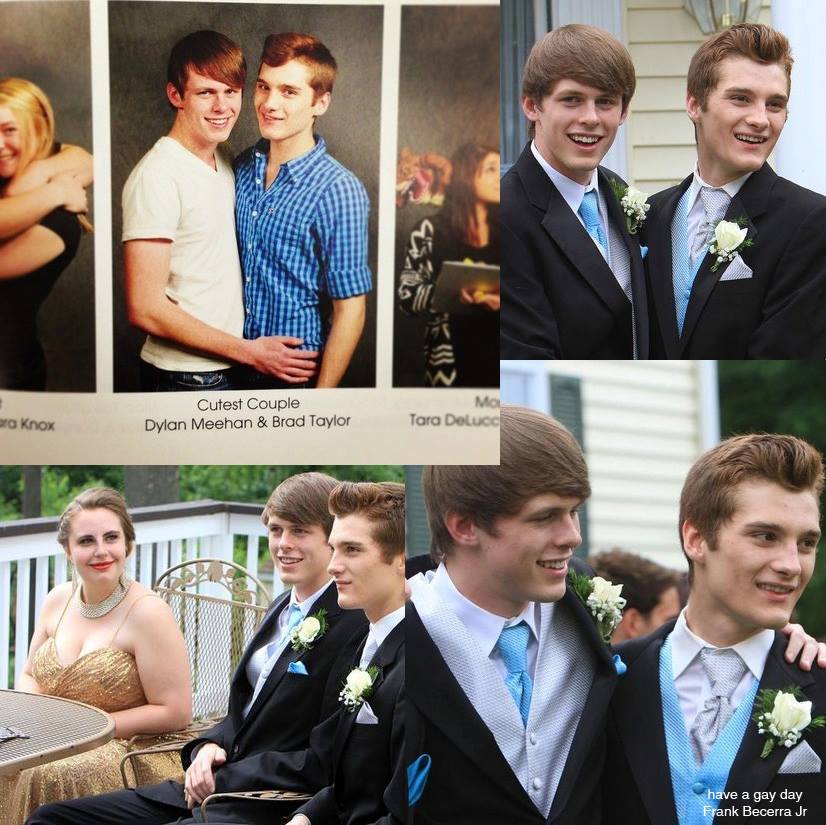
Bradley Taylor and Dylan Meehan, voted their high school’s cutest couple. This montage courtesy the “Have a Gay Day” Facebook group.

Carmel High School students Bradley Taylor and Dylan Meehan hold hands as they discuss the whirlwind of publicity they have received these past few days.

Just hours away from their senior prom Monday, Taylor and Meehan donned tuxedos with coordinating blue and silver vests and ties, living up to their newfound class designation. Last week, the two were named “cutest couple” in their yearbook’s senior superlatives, sparking international attention for the gay teens.

via Carmel H.S. ‘cutest couple’ become Internet sensation | The Journal News | LoHud.com | lohud.com.

I love the idea that these kids don’t see anything abnormal about a same sex couple being voted “Cutest Couple” in their senior superlatives. I, on the other hand, find it breathtaking and utterly astounding. And also as evidence that these young people will be more capable leaders of the world than my generation — and most assuredly more capable than the generation or two that came before me.

The great video that accompanies this story shows Dylan and Brad and their friends getting ready for their senior prom in Carmel, New York, north of New York City.

My high school prom was held in 1982. If I would have said I was attracted to a yak and wanted to bring a yak to the prom and let it crap on the dance floor, it would have caused less stir than if I said that I wanted to bring another boy. It just wasn’t done. Not only that, no one — certainly no one that I knew — ever even thought about it.

I cannot even imagine the world that these young people live in, but I am ecstatic that it exists for them. I hope it exists for everyone soon.

Remember this: no old person ever changed the world. Let’s make way for our young people; they know better than we do. That’s how change happens.

(Also, every now and then it pays to know your history. Written by John Lennon and released by The Beatles in 1967 was an anthem with the following line: All you need is love, Love. Love is all you need. Truer words were never spoken [well, sung]. Note that there’s no gender inferred or implied. Love is love, Love.)