Charm of DAYS’ Gay Supercouple “Cannot be Denied”

Whether or not the sand runs out on Will and Sonny is up to the writers and others involved. There is word (though not officially confirmed by the actor) that Massey doesn’t plan on returning to Salem after his contract runs out this December. Still, fans can currently enjoy the ups-and-downs of one of (if not the biggest) daytime television power couple. Even if you are not a fan of Days of our Lives or soaps in general, the presence, power, and charm of the couple cannot be denied.

via Andrew Benkovic: The Daytime TV Power Couple That May (or May Not) Surprise You.

I agree. Benkovic’s piece on HuffPo is good, especially given that he’s very upfront about not being a longtime Days of Our Lives fan — or soap fan in general.

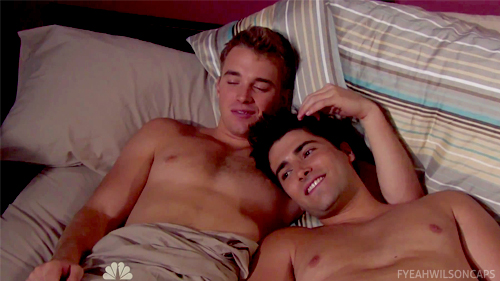
GAYTASTIC — Will Horton (Chandler Massey, left) and Sonny Kiriakis (Freddie Smith, right) have emerged as one of the most popular couples on the NBC daytime serial “Days of Our Lives.” Powerful and immensely likable performers, Massey has received three Emmy nominations and Smith was nominated in 2013. Massey won in 2012 and 2013.

The latest machinations with Adrienne talking trash and Will doubting himself and doubting Sonny’s commitment to Will and the baby have served to derail the post-partem/post-gunshot euphoria the duo has been experiencing of late, but I think it’s a good little ripple — even though I want to backhand Will sometimes — and it serves to reinforce the idea that Will’s self-confidence is only about an inch deep. I mean, if Sami Brady was your mother, how confident would you be?

Lots of drama on the boards right now about Chandler Massey leaving after his contract expires. I’ll take that with a grain of salt right now. NBC and Ted Corday would be damn fools to let him walk away when he’s one of the most popular characters on the show right now and soaps are no longer a dime a dozen. Given taping schedules, we’re likely to see him full time until next March or April. Smart producers would throw money at him and work around his college schedule by back-burnering his story for six months at a time. Plus, you keep Freddie Smith in the forefront and, other than making ME happy, it reminds the audience of the importance of the couple to the Salem landscape. And besides, we’ve never had a long-term gay couple on soaps — and no, Noah and Luke don’t really count as long-term, as much as I loved them — and we need one.

Also, Freddie alluded to something in an interview a while back and I’m interested to see what transpires. Watch this space in October. We’ll see if I’m right!

(Click around here, if you’re interested in this; it’s been one of my favorite subjects of late.)

Cady McClain, the Decline of American TV Soaps, and Other Stuff

Here’s a link to a great article by All My Children’s Cady McClain about the decline of soap operas on American television. Alert readers will know that this is a topic that I broach with some frequency because, in all incarnations of my life, I have been and continue to be a storyteller. And one of the best ways to connect with your audience and tell important stories is using the serial format.

I have a lot to say on this topic, but I’ll save it for another day. Read Cady’s piece. She’s bang on; absolutely bang on.

As for the haters that are drawn to comment on her piece (which she tweeted about), I offer up this great piece on the subject courtesy of Mashable. I originally posted it a few months back.

Finally, below I am reposting a piece I did for Salon back in 2010 when As The World Turns was going off the air. It touches on some similar themes and also Cady and I quote from one of the same sources, Robert Allen, who wrote the terrific book, Speaking of Soap Operas, back in the 80s! All great minds…..?

P.S. In re-reading the piece below, it occurs to me that I’ve used the Schemering quote in more recent pieces. I should research more deeply. Still — it’s a great quote!

_____________________________________

LOSING OUR STORIES
On Friday, September 17, 2010, the soap opera As The World Turns goes off the air after a run of 54 years. A significant event? Yes, I think it is.

“We are a narrative species,” wrote Roger Rosenblatt in Time a decade ago. “We exist by storytelling — by relating our situations — and the test of our evolution may lie in getting the story right.”

I have always found true profundity in that quote and I have gone back to it hundreds of times because all of us relate to students, to colleagues, to friends, acquaintances and strangers, by telling our stories. And I often wonder if a generation gap is not widening because our outlets for teaching young people how to develop, expand and express their own stories have severely diminished in recent decades.

By way of example, we seem to be reaching the bitter end of serialized storytelling, something which can be dated back more than 500 years to Persian storytellers. Serial fiction became wildly popular in the 19th century with Charles Dickens, most famously, and other authors who published stories in magazines by installment. In the U.S., serialized stories began to be broadcast daily on radio in the 1930s. Derisively called soap operas, as most were sponsored by household products manufacturers and featured overly dramatic plots, they fast became the chief escapist fare for an audience of millions; most of whom were women.

If not the originator of the idea, certainly the most prolific purveyor of soap opera was Irna Phillips, an iron-willed, opinionated genius who acted-out her stories for a secretary to transcribe in lieu of literally putting pen to paper.

Character First
When Phillips created As The World Turns in 1956, it fast became the number one drama in America and stayed at that top spot for more than two decades. In writing about the program, Robert LaGuardia called Phillips “ahead of her time. … Irna saw daytime drama in terms of time and character, rather than story. She understood something that only loyal soap fans truly know: that people want to become involved with the lives of other people. … Story to Irna was simply a vehicle; it was from the moment-to-moment emotions of her characters, expressed to each other in quiet scenes, that viewers derived true vicarious pleasure.”

Soap operas exploded thanks to the advent of television and at the height of their reach some 30 years ago, daytime dramas reached a staggering 50 million viewers a week and raked in more than $700 million in profit annually. The size of the soap audience, argued essayist Robert C. Allen, made the programs “a significant cultural phenomenon.”

In the often laconic pacing of daily serials, audiences get to know characters on a level more intimate than in episodic storytelling and their emotional investment in those characters intensifies. The late Christopher Schemering, a journalist devoted to daytime drama, once noted that “as characterizations grow and the narrative stretches out over months and years and becomes more complex and ambiguous, one’s involvement deepens, forcing one to come to terms with the quirks of human nature, the darker sides of fundamentally good people. And thus there is the possibility of the viewer experiencing something new or complex or feeling some way he has never felt before.”

Theatre practitioners often say that the purpose of the art form is to illuminate the human condition and, arguably, soap opera’s true calling may be exactly the same.

Old-Fashioned Relevance
While many soaps have been derided over the years for outlandish plots, poor writing and occasional injections of science fiction or utter madness, As The World Turns remained relevant, said Schemering, because it told “powerful stories slowly and surely. The show was old-fashioned in the best sense of the word.” LaGuardia called it the “most historically important soap opera in modern times.”

In its early years, the show introduced what is believed to be the first illegitimate child on television and though the show was never considered cutting-edge like the early days of All My Children — where a young Erica Kane had television’s first legal abortion — the show did not shirk from the exploration of social issues. Over the years, alcoholism, cancer, adoption, racism, Alzheimer’s disease, and many other issues have been mined for stories.

Margo’s Rape
In the early 1990s on As The World Turns, the rape of police detective Margo Hughes was allowed to play out in real time. The character, who had to wait six months before she could take a test to determine if she had contracted HIV/AIDS from her rapist, was allowed to explore her own emotions, those of her husband, family and colleagues, and the impact her rape had on everyone in her life in a way that mirrored what happens in the real world. Nearly 20 years after this story first aired, actress Ellen Dolan says that it remains a touchstone for long-time viewers.

Luke’s Coming Out
The show has also, in recent years, been lauded for its long-term treatment of Luke Snyder’s homosexuality and its sensitive portrayal of young gay men. When the teenager came out to friends and family, he was met with both acceptance and derision, often from surprising or unexpected sources, but the character was allowed to hold to his own truth and the story showed the long-term positive effects of that truth-telling on members of the community.

And while soaps can be innovative and forward thinking, they can also be prudish. When the character of Luke fell in love with Noah Mayer, a young man with a completely different, harsher and occasionally frightening coming out story, the two finally shared daytime’s first gay male kiss — nearly a decade into the 21st century.

A gripping story such as Margo’s rape showed millions of women how one woman, married with children, reacted to such an unspeakable act and how it impacted her life. Luke and Noah’s story was written with intense courage and deep feeling and showed how one town accepted and embraced people who may have been different. Both stories allowed viewers, some of whom may not have had other avenues in which to explore them, new and potentially empowering ways to confront difference and prejudice and violence in their own lives.

A Real American Drama
Nearly 50 years ago, playwright William Inge said that while people may sneer at soap operas, they have “a basis for a truer, more meaningful drama. … I feel that in soap opera we have the roots for a native American drama.” Inge may have been right, but he could not have foretold the societal shifts that have occurred over the last three decades that has pushed the soap opera onto a cultural endangered species list.

Soap opera viewership is down a staggering 30 million weekly viewers since the mid-1980s and the number of dramas on the air has shrunk by more than half as well. The news from the Nielsen ratings continue to show a continuing sharp decline across all daytime dramatic programs in women viewers 18-49, the bread and butter demographic for soaps. In an era when working outside of the home is the norm rather than the exception for both genders, when DVR’s have released viewing from time constraints and online video has even freed it from TV sets, the soap audience has dwindled and is increasingly split between older viewers and teenagers; neither is a group that excites daytime’s traditional advertisers.

“There are two universal human needs or motives,” a colleague of mine wrote recently, “the need to know and the need to belong.”

That’s as important, I believe, as Rosenblatt’s assertion that “[w]e exist by storytelling.”

If Rosenblatt is correct, what becomes of a society that loses its stories? What happens to people who forget who they are or where they came from or who their ancestors were or how they deal with fellow citizens in a crisis? How do we write our history if we have no stories to tell? If there is a primal need for knowledge and belonging — and I fervently believe that there is — how can we satisfy that need if no one tells us our own story? How do we move forward if we cannot add to the narrative? How do we entertain each other without a collective act of imagining? How do we continue to educate future generations if we have no stories to bind us together?

You may be thinking this is all well and good, but when you get right down to it, it’s just a soap opera; it’s just a television show. Does it really matter? I think it does. And I think that any story that can be told without a break for more than 50 years, such as As The World Turns, deserves to be celebrated and its passing deserves to be mourned.

There are still people who need experiential outlets and serial drama may be an important and overlooked one to help people deal with their personal issues and to teach them to tell their own stories in a meaningful way.

What happens to those folks when we can no longer “tune in tomorrow?”

Pine Valley Is Open For Business Again

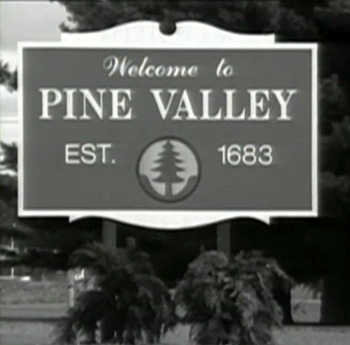
Pine Valley(4.29.13) — Today is Welcome Back to Pine Valley Day. (Or if your preference is just down the road, it’s Welcome Back to Llanview Day.) It’s the day that the Internet reboot of All My Children and One Life to Live begins.

It took me awhile, but I pinpointed my first viewing of AMC to the spring of 1982. I was a senior in high school and I had been, since before I even knew any better, a viewer of CBS soap operas — As The World Turns and Guiding Light, specifically. I couldn’t help it. That’s what my mother and my aunt and my grandmother watched. I couldn’t go anywhere, it seemed, during my childhood without having a CBS soap playing in the background.

That spring, a friend of mine called me on some holiday from school and demanded I turn on All My Children. (There was a lot of watching television while on the telephone in those days; just go with it.) She said that I had to watch this one crazy character because it reminded her of her mother. The actress was Dorothy Lyman, the role was Opal Gardner, and I thought it was hilarious. (And yes, Opal was a lot like her mother, as scary as that may be to contemplate.)

If Opal, Glamorama and all, got me to open the door, the rich, multi-generational tapestry of characters in Pine Valley invited me to the party and demanded that I pull up a chair.

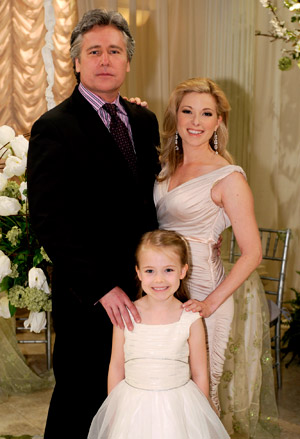
The cast of the "new" All My Children includes many familiar faces, including original cast member Ray MacDonnell and longtime co-stars Cady McClain, Jill Larson, David Canary, Julia Barr and others. Image: Ferencomm/The Online Network.

The cast of the “new” All My Children includes many familiar faces, including original AMC cast member Ray MacDonnell and longtime co-stars Cady McClain, Jill Larson, David Canary, Julia Barr and others. Image: Ferencomm/The Online Network.

One of the creepiest characters in TV history, Billy Clyde Tuggle, assayed brilliantly by Matthew Cowles.

Creepy Billy Clyde Tuggle, assayed brilliantly by Matthew Cowles.

Watching AMC in those days was not just about watching the hot youngsters —Jenny and Greg and Angie and Jesse and Tad and Liza — it was also about watching Benny Sago spar with “The Duchess,” the one and only Phoebe Tyler, it was about the Charles/Mona/Phoebe triangle, it was about Langley and Phoebe and Myrtle and Opal, it was about hooker-with-a-heart-o’gold Donna Beck and Chuck Tyler, it was about Erica Kane and Tom Cudahy, Brooke English and Tom Cudahy, Palmer Cortlandt before Adam Chandler came to town, Nina and Cliff, Ellen and Mark, Joe and Ruth and Grandma Kate Martin, the best soap opera villain ever, Billy Clyde Tuggle. And “Bonkers.”

Great memories of stories well-told, but they are the stuff of television lore. They are the stuff of history as much as this iconic show opening:

When ABC announced the cancellation of AMC, I started to watch it again. I hadn’t watched much in the decade before the cancellation and I have it on pretty good authority that it was nothing like the Agnes Nixon-penned salad days of the 70s and 80s. The first thing I noticed was that Tad Martin had grey hair! Tad the Cad got old? What the hell? I just couldn’t get over that. I mentioned it to a friend and fellow viewer. He suggested that I should look in the mirror. Oh. According to the AMC bible, Tad and I are the same age. Dammit.

MEKnight14tad03Still, I can mourn my lost youth, I suppose, but, then again, I don’t actually want to see the same things I saw in 1983. I don’t want to watch the same stories again and again. I want to be excited about new stories and new ideas. Isn’t that really the point?

(And the other point is that Michael E. Knight and I both aged gracefully and we still look fabulous, grey hair and all!)

Anyhow, today is a new day in Pine Valley. Like Brigadoon, it’s risen again and is ready to let us in. Maybe some of your old favorites won’t be there. Maybe you’ll be looking for The Goalpost or the Valley Inn or the Glamorama. Maybe they won’t be there either. But just like in1970 at the first beginning, Joe Martin will be there (God bless Ray MacDonnell!!).

Dixie Cooney will be there. And Opal Cortlandt. And Jesse and Angie Hubbard. And Brooke English and Adam Chandler. And a whole lot of young people that you don’t know yet. And that shouldn’t scare you away. That should excite you. It’s a new day. In the world and in Pine Valley.

Oft-repeated through the years — and for awhile seen in the opening credits, I believe — is the poem from Agnes Nixon’s AMC bible:

The Great and the Least,
The Rich and the Poor,
The Weak and the Strong,
In Sickness and in Health,
In Joy and Sorry,
In Tragedy and Triumph,
You are All My Children.

Nixon’s All My Children has always been about just those things. Today, they begin telling new stories in a new medium with both familiar and new faces just like always. I have a feeling this day may mark the beginning of a new day of serialized storytelling in this country. That hope — that we can again tune in tomorrow — or at four a.m. or watch from our phone on the train on the way home from the office — makes this a very good day indeed.
__________________

The incomparable Ruth Warrick.

The incomparable Ruth Warrick.

P.S. — I spent many years of my working life in the theatre. I don’t get star struck. I have met and worked with many famous personages, but my autograph collection is very, very small. The only person from a daytime drama I have ever deliberately sought out to meet and to sign an autograph was the late Ruth Warrick. I thought she was an absolutely brilliant actress and there have been very, very few characterizations ever that rose to the rarified level of Phoebe English Tyler Wallingford.

Would that the ‘Duchess’ could see Pine Valley reborn. I’m certain that she and the rest of the Daughters of Fine Lineage would be pleased!

Watch Now!

Soap Resurrections Online Excite AMC’s Cady McClain

Tad_and_Dixie_-_Michael_E._Knight_Cady_McClain_AMC

Michael E. Knight and Cady McClain as Tad and Dixie on ABC’s “All My Children.” The show returns online next month as one of two former network serials getting another life online. McClain returns to her Emmy Award-winning role as Dixie in the reboot. No word yet on Knight’s participation. Image: originally SoapNet, via Wikimedia Commons. No copyright claimed.

If you know the actress Cady McClain, you are likely a viewer of serial drama. She rocketed to the top of the daytime drama Hot Character Hall of Fame for her portrayal of Dixie Cooney Martin on All My Children on and off from 1988 to the end of the ABC series in 2011. She is also known as the second Rosanna Cabot on As The World Turns in multiple stints for the last eight years that soap was on the air.

McClain returns to Pine Valley as, in classic soap fashion, it rises from the dead for an Internet reboot from the production company Prospect Park and their Online Network. The show will also be available on Hulu and iTunes in 30-minute episodes.

It’s a brave new world for what we used to call “daytime drama,” but dramatic programming on the networks during the day is flagging as the core audience — stay-at-home moms and other women who do not work outside the home — continues to dwindle.

I’ve written any number of times about my feelings about serial drama and how important it can be as a catalyst for societal change. I hope that by making the once venerable and still much-loved serials All My Children and One Life to Live available online, we are seeing the beginnings of a more mainstream acceptance of Web-based entertainment.

Read Cady’s cut below and feel free to click around to stories that I’ve written (or reblogged) about soaps and Web series over the last year or so.
A New Dawn for Daytime | Cady McClain.

Do you remember when your aunt or grandma or mom called you into the living room to look at her soap opera on the TV, screaming, “OH MY GOD YOU’VE GOT TO SEE THIS” and that moment when you frantically queried, “What’s happening? Who is that? TELL ME EVERYTHING!” Well the same thing is going to happen, only now it might be in reverse. Your niece or daughter, or grand daughter might now be the one hollering, “OMG! You’ve got to see this!” while pulling out  her laptop, tablet, or smart phone. It’s not so different: it’s still a generational connection that is going to occur, it’s just coming to you via a different mechanism.

SOAPS AND SERIAL DRAMA

WEB-BASED ENTERTAINMENT

PS — There’s likely some overlap in these two categories.